Advance preview of the Prologue to my ecofeminist Harry Potter meets Dan Brown meets Neal Stephenson-like science-fiction/fantasy novel-in-progress staring a young girl (rather than a young boy) and semiotics and cognitive science instead of magic. Note: to save space, the dialogue between characters runs together, and is separated by quotation marks rather than by a new paragraph each time a character speaks. What follows is a draft in progress. Comments welcome. wmjcoletta2@gmail.com
Emily Norah Clark and the Case of the Ten Commandments 2.0: The Three-Body Potential
by Dr. Marko Clark (aka Dr. Wm. John Coletta) Prologue 1 of 4:
Time: 10:00 am, June 16, 2029 Setting: Sunday School Class Characters: Emily Norah Clark, her brother Karch Clark, the Sunday School teacher, other kids in the class, Mary Talking Stone Context: Emily is twelve years old, and a little “forward.” She kind of talks like a professor’s kid, too, because she is, just saying. Oh, and Karch, as soon as he realizes that Em’s “going to be in trouble” again for speaking out, recognizes a real TikTok opportunity, and starts recording what follows.
“Emily, can you name one of the Ten Commandments?” asks Teacher Blank. [We’ve got to honor Mrs. Blank’s privacy, but the kids call her “Hats,” just saying.] “Ten Commandments, did you say, ma’am? How about the Ten Compassions, or maybe the Ten Contracts? ‘Commandments’ is a bit pushy. Or how about the Ten Algorithms? The kids in class all gasp. Hats’ hat shifts a titch as she shakes her head and frowns; Karch starts covertly recording his sister’s theatrics. (He’s hiding his phone behind his open Bible.) And then Emily continues, answering Hats’ question while at the same time deeply undermining her question: “But, to your point, instead of, say, ‘Thou shalt not have any other gods before me,’ which is a little self-centered, how about ‘Thou shalt not pollute,’ or ‘Thou Shalt not go to war’. Can you imagine how different the world would have been had those two compassions made the cut”? Silence. “No? Ok, then, what about “Thou shalt not stereotype?” More silence. Hats starts to say something, but before her reaction registers with Emily, Em in effect cuts her off, saying, “Really? Nothing people? Well listen to this, then!” And then Emily takes out her cellphone, which she was supposed to have checked at the door, lol, stands up, and begins reading out loud to the class from a publication she made to her Substack account:
Stereotypes are a kind of “graven image,” and remember that “Thou shalt not make unto thee any graven image, or any likeness thereof that is in heaven above, or that is in the earth beneath. “See, teacher, I’m answering your question!” And then one of the kids asks, without first raising a hand, which is cool—it’s a conversation Emily thinks, “What does a graveyard image have to do with the Ten Commandments, Emily?” “Thanks for asking, Ray, but it’s ‘graven’ image, not ‘graveyard’ image, though gravestones, by definition, contain graven images, you know, words and pictures engraved, chiseled, in the stone, so good work! But a ‘graven’ image in the context of the Ten Commandment means that we honor or worship the image instead of what it represents. Like worshipping a dollar bill more than the services of the people and the planet that the dollar represents. The term ‘idolotar’ is used to describe those who worship the image rather than what it stands for. Oh, and stereotypes about groups of people? They are graven images too, as in we believe what the stereotype says more than what the people say! The kids seem to get that, and then Emily continues reading from her Substack account on her phone: Stereotypes are often “graven images” about groups of people. And if you don’t question a racial or gender stereotype, you might rightly be called an idolator. But, no. All we talk about in my church are the supposed idolatries of other people’s religious beliefs, not our own everyday idolatries!” The kids seem a little lost, and Em hears something about “professor’s kid”, but Em continues, “Or how about the GMO foods that we eat downstairs at every church pot-luck (or pot-Providence, according to our Pastor)? Those GMO foods are “graven images” too—“graven images” of the real food in the Lord’s “earth beneath,” to quote the commandment. And did you know that GMO corn has lost the voice that the Lord gave it at Creation; for example, it can no longer call on wasps to come and control caterpillar corn infestations. Idolatry is a shuttering of the voices of Creation, of not listening to the Word in Conversation. “Uh, Miss Emily,” cuts in Teacher Blank finally, “enough is enough. Now please sit down. You are getting us off track.” (Let me note, that Em’s bro Karch, quick as he is with his phone, was able to catch on camera Teacher Blank’s comment and request, along with her magnificent height and stellar hat, and then still swing back to catch his sis’s response. Dude is all about anticipatory filming and dramatic effect, and thousands of TikTok followers.) “Well, teacher Blank, didn’t you want us to weigh in on the Ten Commandments? I’m almost done,” and then Em continues reading: Idolatry is a corporation growing GMO corn and then corporate Christians calling Indigenous people around the world idol worshippers for ceremoniously honoring Corn for having a voice that the Lord gave it. They aren’t making an idol of corn in their worship. The images themselves of corn are not worshipped. The images are signs that point past themselves to the Great Spirit. Let the Corn speak. Let the Word grow. Jesus is the Word and the vine and the corn. I’m just a little pissed.” And then Emily closes with, ”If you like what I am saying, please consider subscribing to my Substack publication. Thank you.” Em then sets her phone down on the table with a loud clack, kind of like a mic drop, and sits down. And the reactions of the kids, mumbling under their breath, range from “Huh? What? Isn’t ‘pissed’ a swear word? Using Sunday School for sales pitches? to Yikes! And then silence. Looking around the room, Emily sees that the faces of all the kids have, in a sense, turned to stone tablets, lol, and are etched with either a grin or a grimace. Teacher Blank, or Hats, decides to go on the offensive. “Emily, what did I hear you saying to Johnny before class, that the first commandment was a little self-defensive or arrogant and wasn’t really needed so much now?” And Emily thinks to herself, “Ok, busted! So here goes,” and then she says out loud, “Well, not exactly, Mrs. [Blank]. Johnny thinks that I was ‘dissing’ the First Commandment, and I get that, but in my mind I’m just broadening its interpretation. “Thou shalt not have any other gods before me” is precisely what the Pope is addressing in his Encyclical and what I have put into Ten Commandment language: ‘Thou shalt not allow AI or any technology to take away the dignity of the human spirit and work.’ The Lord knew that the First Commandment, in its original form, did the work it needed to do at the time; the Lord also knew that we’d someday need to take that First Commandment and tap into what my iMom (or mom-e) calls its “living potential”—“the Word in Conversation,” the Holy Spirit—and use it to put AI in its place, once AI became a thing. And now some have replaced God with AI and the Second Coming with the Singularity. Well, that comment put an end to the silence, as a wall of giggles explodes from the kids. And Hats doesn’t know what to say. But she says anyway, “Miss Emily, I don’t know where you are getting these ideas, . . .” But Em cuts her off, “Uh, I read books.” “. . . but you can’t edit God’s work! His Word is once and for all. You are disrespecting God.” “Oh, thanks for bring up God. That reminds me,” Emily says, feeling that she is ‘on a roll’: “How come it’s always ‘God the Father and the Son’? Why never ‘God the Mother and the Daughter’?” Now those two lines the other kids sort of understood, and you could feel it in their shifting in their chairs. Little Sally even did what looked like a fist pump! “But more than that, ma’am—are you really going to tell me, a young girl who’s just discovering herself and her power in this world, that the universe is organized around a Him? That’s so embarrassingly and transparently a male power move! I’m out! Pause. Bam! Mic drop number two! “My Goodness, Emily,” says Teacher Blank. “Please take out your spiral notebook, go to the back of the room, and copy three times in long-hand Exodus 20: 1-17. Em gets up. She does walk to the back of the room, but then she walks out the back door and out of the church altogether. [Yikes, Karch thinks, as he stops recording.] Em skips across the church parking lot and into the coffee shop next door. There, like a 1960s Freedom Rider, twelve-year-old Emily sits down at the counter and orders a bubble tea. She can see the church parking lot from where she sits and waits patiently for when her parents will arrive to pick her up—“from church.” Oh, and while sitting at the counter sipping her bubble tea, Emily writes, in her spiral notebook, the poem “I and I,” which you can find in the sidebar. You go, girl. (And “go” she did. Later that day, brother Karch shared his vid of Em’s “church break” on TikTok, and he titled it “Emily N. C.? A Moses 2.0?” Oh, and dude is a creator. The video had 27,547 views the first week.)
I and I
by Emily Norah Clark
We are speck-in-time mortals
With immortal responsibility.
Time is an invisible net
Stretched so fastly away,
Ooh! I hear it singing.
I pluck the grass so children live;
The dead keep talking;
And I am a dandelion seed floating
On a million ancient sighs.
Taking the book in my hands,
Breaking the center that binds,
I eat history for breakfast,
Spitting out the stale Word
For the living One.
Last summer in an orange
Warms me and makes
My hair glow gold.
The seasonings run round and away;
The moon swings as it dips,
Now a horn so sharp it pricks
The sky and the night gasps.
You kill people each day:
Ah, the perfect crimes;
The dying, like snowflakes,
Silent and little felt,
Asleep in our hair,
Endlessly slip away.
I pluck the grass so children live.
Climbing, I reach the peak
and see the city of tomorrow in my eyes,
a city of pools of light,
where forests are both free
and folded as circuits.
We come to drink as fawns,
And run into the green city
Pulsing deer-like.
Picking up a rock,
A sign of the Singularity,
I throw it into orbit;
It disappears over the far-arching sea.
I know what power is,
And I am only a girl of twelve.
[The narrative proper continues below.]
While Em is writing at the counter, another girl (or even a very young woman), maybe 17 or 18, takes a seat on the stool at the counter right next to Emily.
“Hi,” she says, to Emily, “I’m Mary Talking Stone.”
“Hi, Mary Talking Stone. I’m Emily. But I gotta ask, ‘Where have you been?’ You’ve got an ‘I’ve just got back from somewhere cool’ look!”
“Well, yeah! I’m headed back from Indigenous Science Camp, a two-week program called Restoring the Kinship Worldview: Indigenous Science and AI.” I’m a Cognitive Science major and an Indigenous Studies major at Dartmouth, with a minor in Forensic Semiotics, though my minor is an IDM. I designed it with an advisor after reading two cool detective novels, Wordhunter and Codebreakers. I’m back for the summer, headed to Keshena, my hometown. My mother is Omeaqnomenewak, Menominee, though my late dad was of Irish heritage. He studied Old Irish, and the pre-Christian Irish culture, so I’m Indigenous on both sides, as I like to say! But what brings you to this coffee shop, all alone, Emily?”
“Well, I kinda just got kicked out of church!”
“Is that a bad or a good thing? I remember when the ‘man’ tried to kick me into church,” replied Talking Stone, laughing out loud.
“I was arguing that the Ten Commandments need an update—and then I called out Hats, uh, Teacher Blank, on the whole sexist ‘God the father and the son’ thing. I actually said, ‘How come it’s never God the mother and the daughter!’ That didn’t go well. So here I am.”
“Hey, I’m with you girl! And to your point, about the whole patriarchal, God the Father and the Son thing, I’ll think you’ll find it interesting whom I supposedly met last month? The last semester of this past school year, I was at a city park competing in a Pokémon Go, Augmented Reality, tournament. Well, actually, was with my team, and we considered the tournament a kind of training exercise for our Autonomous Avatar, Spirit Stone. We had created Spirit Stone using a Unity game engine . . . “
And then Em jumps in with “Let me guess! You’re pairing your Unity game engine with Inworld AI?!”
“Geez, Emily. You must work in the gaming world too!”
“Yep. Anyway. Keep going. Sorry!”
“So, yeah. By pairing my Unity game engine with Inworld AI, we’re training Spirit Stone to play Pokémon Go, that is, to use my phone t(from inside my phone) to interact with his Buddy Pokémon, in-Game NPCs, and Wild Pokémon. But here’s the crazy thing, though I don’t know what to believe. As we are tracking down a Grunt at a PokéStop, trying to rescue a shadow Pokémon, who do you think does a ‘fly by’? Pikachu? Eevee? Charizard? No. Jesus!
“Of course he did!” said Emily, with a little snark.
“Well, it didn’t stop there. Jesus was accompanied by Shejus+ and Wejus too, as well as by Skywoman! Or so they claimed, lol. And Skywoman? For us Menominee people, Skywoman is a key divine female figure, and then to see that Jesus had siblings and that they were hanging with Skywoman, well, I was for a moment transfixed, but then I found myself thinking that ‘Skywoman’ and the three Jesuses must just be some boutique avatars created by another cutting edge lab. I mean, I knew that they weren’t Pokémon Go avatars!
“Well, Mary, I think that your story would have gotten you kicked out of Sunday School, too,” and Em breaks out laughing.
Mary Talking Stone laughs, too, and then says, “Right?! And then I found myself thinking (I mean, I study North American Indigenous history in college), ‘Didn’t my grandfather always say that the Spirit World was non-binary, lol, a continuum—but a continuum of Jesuses?!’ Of course, Emily, I then actually asked Skywoman and Wejus (J3sus and Shejus+ were picking blueberries off a bush like a couple of birds), ‘Uh, so, folks, I’m thinking you’re autonomous avatars, then, in somebody’s AR videogame? Who’s training you?’ And Skywoman laughs, saying,
‘Well, no, actually, Speaking Stone, we aren’t avatars. Nobody created us. In English, we are EDENS, Eternal Digital Entity Networkers. We predate, of course, your computers, your AI avatars, and your VR and AR gaming environments, but we are happy to hangout, “like fairies in one of your storybooks,” according to a young lad we just interviewed, in, on, and around your devices now that you are beginning to catch up to us.’
So, Emily, tell that to, uh, your Sunday School teacher, Mrs. Hats was it!”
“I know, right!” And Em is like, “We gotta talk. This is too crazy! Good thing, though, that I am still a skeptic, but who would’ve thought that ‘Is it Divine or is it AR’ would be the question of the day? Can I buy you some bubble tea and a donut, Mary Talking Stone?
“Sure. I’ve got maybe a half hour,” says Mary Talking Stone, “But there’s more.”
“More? More donuts? More than three Jesuses?”
“Well, not more Jesuses, Emily. More EDENs! And now I’m not sure what to think. Oh, and I didn’t meet them in a city park playing Pokémon Go.”
“Well, where, then? in church?”
“No. In a videogame.”
“Inside the game?”
“Yep! I was playing Genshin Impact three days ago
during some free time at camp, and I found my avatar oddly drawn to this procedurally-generated mountain in the distant landscape of the game. And whom do you think I find hanging around the foot of the mountain?
“Well, Skywoman, J3sus, Shejus+, and Wejus?”
“Yep, and, as I mentioned, some other EDENS, too!”
“And did they tell you what they were doing there?
“Yep. Here. I recorded the whole meeting, and I saved it to my phone. Let me play a snippet for you. I had just asked Pan—yeah, with the pipes!—that very question: “What are you folks doing here?”
“Well, we’re here because of what we hear, and we’ve heard that there’s to be this new “issuing,” a Big Reveal. You know, ‘In the Beginning was the Word in Conversation’, and I guess the conversation is continuing, though we’re not sure about the timing. We were just about to head up to the mountain top for what the Samurai call a “viewing party.”
And then, Emily, I asked, “To view what?”, wondering though how Divine Beings like Skywoman and Wejus et alia could be unsure of the ‘timing’.” And Wejus replied,
“Just the setting, the stage, the staging grounds themselves.”
“And then Skywoman adds, about the ‘timing’, though I hadn’t asked that question out loud, as if she had read my mind,”
“Oh, and about the timing, we aren’t sure about the timing, but that’s because we made it that way.”
“ ‘Ok, then,’ I said to Skywoman. But, Emily, as you might imagine, when I heard Skywoman say, ‘because they made it that way’, I was both impressed and confused. And then, as I stood there at the foot of the mountain and in front of the EDENS, it all came together in my head in a second, as if the elements of the thought had been planted together in my mind like corn, beans, and squash. And here’s might thinking, Emily. What else could a ‘Big Reveal’ of the ‘Word in Conversation’ mean—especially in the context of a mountain and the EDENS—but a Ten Commandments 2.0 event. And as for all-knowing Beings being ‘unsure of the timing’? Well, a question of timing, or time, Emily, is, as my cognitive science prof told me, always connected to space.”
“Ok, Einstein, keep going.”
“And as concerns space, why would the Lord choose a virtual mountain top inside a videogame as a Mount Sinai 2.0? Crazy, right? That makes no sense . . .
“My thought, exactly.”
“. . . but then I thought, wait. In a procedurally-generated videogame like Genshin Impact, events aren’t revealed ahead of time to passive recipients at pre-ordained times. Gamers playing Genshin Impact make their worlds, generate the landscape before them, via the choices they make—just like people in the real world. We make our luck, or the world conforms to our expectations of it, or we see what we want to see—Let those who have eyes to see, see. But, still? Really? A mountain in a videogame over a real mountain? But then I thought: But the virtual world (the VR) does have some PR advantages (VR PR!) over the real world. And it was then, as if Skywoman, or my AI Agent Maize, had read my thoughts, that the following popped up on the inside of my gaming goggles:
The Big Reveal is co-generated by the interpretive movement of believers, the timing of which Skywoman and the Three Jesuses monitor but choose to put into our hands. Therefore, Skywoman can say, “we aren’t sure about the timing, but that’s because we made it that way,” meaning: we have free will.. You just need to reread Ephesians and N.T. Wright.
And that, Emily, is when I also began to assume that the Big Reveal 2.0 might be an upgrade of the original set of algorithms, an attempt to stop the “killing in the name of,” even an attempt at an apology to Indigenous peoples all around the world in the form of a reset. Oh, Emily, and Skywoman’s T-shirt read, ‘In 1250, Cahokia was bigger than London.’ And then I meet you at the lunch counter, you, who had just gotten kicked out of Sunday School for proposing that the Ten Commandments need an update!”
“Wow. Crazy. We are gonna have to keep this conversation going after you leave, Mary.”
“Indeed. The spiritual physics of Creation and Augmented Divine Reality (ADR) gaming are solved in a day?!”
“True that, but I have another question, putting
Skywoman and the three Jesuses aside for a moment—because I know that you have to leave soon, as do I. When you mentioned, earlier, that you studied ‘forensic semiotics’ at Dartmouth, I jumped, because here’s another odd coincidence! My iMom and I just started, a few months ago, a small, boutique, semiotics-based detective “agency.” (Let me say, too, that my dad is a professor who does semiotics research, so our agency has some grounding.) Anyway, iMom and I are calling the agency ‘Genesis’, since my mom birthed me, herself, and the agency—in that order!” We’ve only had one case so far, though, lol!
“Mom? iMom? Birthed herself?” queried Mary Talking Stone.
“Oops! Yikes! Sorry! My actual mom died two years ago, when I was ten. My iMom, or mom-e, is a digital version of my late biological mom. It was iMom and I who started Genesis Detective Agency. When my real mom learned that she had brain cancer, several years back, she contacted a neurosurgeon (mom, who had been a hairdresser and a waitress when she met my dad, was going back to school to study cognitive science here at UWSP), and they together developed a plan to have mom’s brain (her connectome) digitally scanned and uploaded to the cloud. So now, my iMom’s “staying” in my and my dad’s tablets, though she does evert when we go Augmented Reality mode, usually on Sundays. Dad and iMom will be here in a half hour to pick me up from “Sunday School.”
“Ok, then, Wow.”
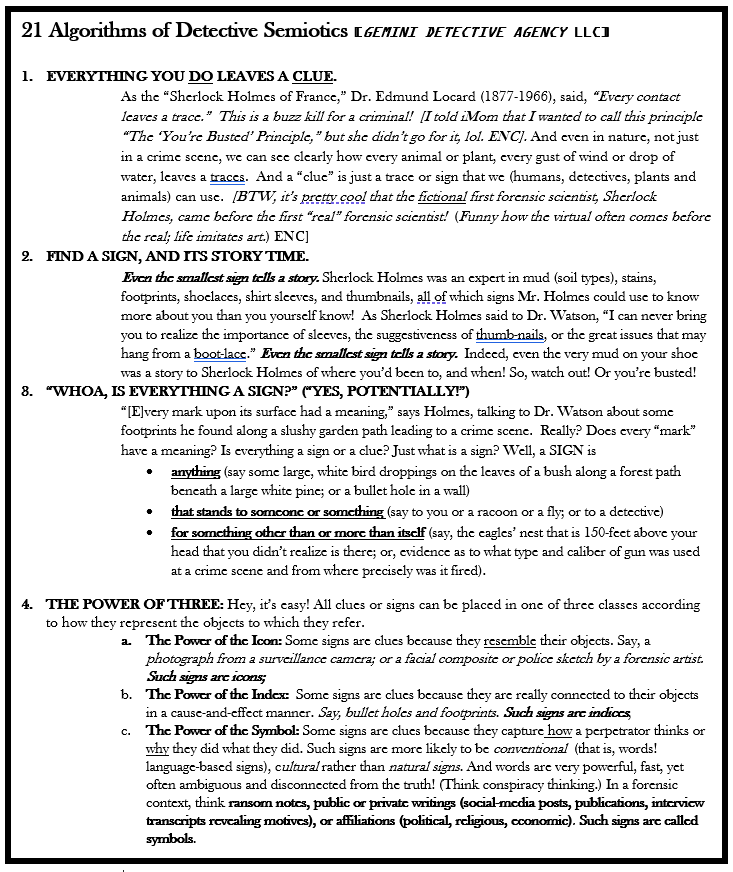
“Now, I realize that you are probably thinking, ‘Uh, and I should join a detective agency founded by a 12-year-old and a connectome, why?’ Well, here’s why!” And Em opens up her phone and looks for a copy of her Eleven Principles of Detective Semiotics that she and her mom were, admittedly, still working on, but which Em thought would show Mary the strong theoretical foundation of Genesis Detective Agency. And then Em finds the file, opens it up, and hands her phone to Mary. [The full document can be found in Prelude 2 below.]
Mary starts reading and scrolling, and she’s like, thinking to herself, “Holy shit. I should let my forensic science profs see this,” and then Mary looks up at Em, after, for real, about 90 seconds of silent reading, scrolling, and thought, and says to Em, “Holy shit, Emily. I think that I need to let my forensic science profs see this.”
And Emily beams. “I know, right?! My iMom’s pretty smart. And here’s my question to you, Mary Talking Stone. If you are a student in forensic semiotics, you must have to do some sort of internship, right? (I may be 12, but I grew up with a professor dad.) So, why not join Genesis? And, of course, you’d be working remotely. So being at school won’t be a problem, and then there are the summers! Heck, my iMom, by definition, can only work remotely! I’m the “incarnated” one in the business, lol, the one who actually sniffs out the clues in real space and time. Oh, and it just came to me! If you came on board even part time, we could call our detective agency not Genesis Detective Agency but ‘Trinity’, Trinity Detective Agency, as in iMom, the Daughter, and the Talking Stone”! And as Emily said those words, a huge smile came over her face. Jeez! ‘Now what would “Hats” make of that, she laughed to herself.’”
“I think that would give Hats the non-Christian heebie jeebies! But, to address your previous question, my Forensic Semiotics advisor did tell me this past spring that next school year I need to be looking for an internship. Do you have a business card?”
Em had already thought of that and was reaching into her purse when Talking Stone made the request. “You bet, here it is, and if you sign on board, we’re gonna make new ones: Trinity Detective Agency.”
“Nice! Well, give me a week to think about it! Oh, and how many cases have you guys had?”
Emily has to do some fast thinking, “Well, if you count the “Case of the Missing Ladle” from three months ago, one.”
“The ‘Case of the Missing Ladle’”?
“Well, yeah. It had been misplaced. But I applied a principle of Sherlock Holmes’ to find it, so that makes it a ‘case’. The principle was “The Principle of Elimination,” you know, . . .
“Yes, I do, lol. “Once you eliminate the impossible, whatever remains, however improbable, must be the truth.”
“Yep! Wow, you’re good. So, when my Mom was dying, we had care-givers in the house. And then the ladle disappeared. By the way, the ‘And’ that I just used is called the ‘causal’ and. It can get you in trouble. Post hoc ergo propter hoc. After this; therefore, because of this. But just because one thing comes before another thing, that doesn’t mean the first thing caused it. And the causal ‘and’ can carry prejudice: ‘They’ arrived, and the ladle disappeared! Darn caregivers! Where are they from?! Had they stolen it? Had they broken it? Had they misplaced it? Or, maybe we were we responsible? But how does one misplace a large ladle in a small kitchen? It’s not like putting a salad fork in the dinner fork tray. And if it were in the kitchen, wouldn’t it have shown up after 3 months? And then, Mary, I knew where it was. (And I felt guilty for having blamed the ‘help’.) Of course it wasn’t stolen. I had made an ‘abduction’, an educated guess, what we now call on the list I showed you, which didn’t exist then, the “Don’t Shun the Abduction” principle: Three months? What hadn’t we used for three months? One of the big pots, that we hadn’t used since Thanksgiving, when we soaked the turkey in brine for 24 hours. The ladle must be inside one of the large pots that hadn’t been used in months and which a good caregiver stored in its proper place (but without realizing that the pot contained a ladle), in the back of the bottom kitchen cabinet where the large cookware is supposed to be stored. This all went through my head in 3 seconds. So, with a huge flourish, in front of brother Karch, who thought I was crazy, and then a formal announcement of the details of my abduction (dude still thought I was crazy), I open the cabinet, reach back in, grab the first big pot my hand felt, heard an internal clang, pulled out the pot, and then pulled out the ladle! Three months of nothing and then 10 seconds of ‘Bam’, and I became a Holmesian for life.
“Bravo, Emily. Case solved! And that, then, was your first, and only, case?”
“Well, I’m calling it so, lol! But, after our conversation this morning, it just hit me. Genesis Detective Agency, Case 1: “The Case of the Missing Ladle”; Genesis Detective Agency, Case 2: “The Case of the Ten Commandments 2.0.” Has there ever been a bigger step up between a Case 1 and a Case 2, lol!”
“OMG! So funny, Emily! And not funny. So serious! Yes, we do have a lot to talk about. Well, I’ve got to bail. So, give me a week, and I’ll get back to you. And I’m excited to finish reading your Eleven Principles of Detective Semiotics.”
Mary Talking Stone stands up, heads out to the parking lot between church and café, gets in her car, and as she pulls out onto Main Street, in drive Em’s dad and iMom.